You need to remove from your life the day-to-day
problems that absorb most people for meaningful parts of their day.
‘You’ll see I wear only gray or blue suits,’ he said.'I’m trying to pare
down decisions. I don’t want to make decisions about what I’m eating or
wearing. Because I have too many other decisions to make.’ He mentioned
research that shows the simple act of making decisions degrades one’s
ability to make further decisions. It’s why shopping is so exhausting.
'You need to focus your decision-making energy. You need to routinize
yourself. You can’t be going through the day distracted by trivia.’
Barack Obama on optimizing decision-making, excerpted from Michael Lewis’s fantastic Vanity Fair profile of the President.Monday, August 24, 2015

Wednesday, July 22, 2015
Lyric Engineering!
Today I read a little about Madan Karky and boy, I was surprised.. He's Vairamuthu's son!
Never had I known this! Also he is a PhD in Comp Sci.
How I got interested in him? He invented the Kiliki language in Baahubali and it's a scientific invention process.
Reading more, I stumbled on his explanation and invention of Lyric Engineering.
I had also read from GVM's post abt his Agaraadhi - a Tamil English Dictionary.
So fascinating! One of the best innovations I'd say.
Also he's an Associate professor in Comp Sci and runs many interesting projects!. Very impressed!
http://madhankarky.blogspot.in/2009/11/lyrics-lyric-engineering.html
http://lifeandtrendz.com/in-an-exclusive-chat-with-madhan-karky-vairamuthu-lyricist-research-associate-software-engineer-and-film-dialogue-writer/
http://www.thehindu.com/features/lit-for-life/all-about-lyric-engineering/article6802046.ece
Never had I known this! Also he is a PhD in Comp Sci.
How I got interested in him? He invented the Kiliki language in Baahubali and it's a scientific invention process.
Reading more, I stumbled on his explanation and invention of Lyric Engineering.
I had also read from GVM's post abt his Agaraadhi - a Tamil English Dictionary.
So fascinating! One of the best innovations I'd say.
Also he's an Associate professor in Comp Sci and runs many interesting projects!. Very impressed!
http://madhankarky.blogspot.in/2009/11/lyrics-lyric-engineering.html
http://lifeandtrendz.com/in-an-exclusive-chat-with-madhan-karky-vairamuthu-lyricist-research-associate-software-engineer-and-film-dialogue-writer/
http://www.thehindu.com/features/lit-for-life/all-about-lyric-engineering/article6802046.ece
Tuesday, July 14, 2015
Manu Joseph's excellent article on the rise and fall of Anna Hazare
It was good, it was brief

He will give many reasons why he is so now, he will give abstract reasons. He will say love is abstract, love is inevitable. It is not, in reality. Love is calculated, always. In America’s caste system, he is nowhere at the top. In fact, at times he feels he is at the bottom. There are moments, he knows, when brown is the new black. Back home he was something by virtue of his birth, his lineage and education, which was clear to all in plain sight. And the riffraff, which knew its place, readily granted him his, unlike in the United States. That is why he loves India. That is why the Third World middleclass and the rich who live in the West are deeply in love with their homelands. Nations that are filled with the poor are feudal in nature, and so excellent homes for the middleclass. India is probably the best.
Resident Indians, despite all their reasonable grudges, experience the privileges every day. That is at the heart of the collapse of Team Anna’s apparent revolution, which called for a battle to the brink to overturn Indian politics, and asked informed Indians to dismantle what ignorant voters had erected. But then there is no genuine trauma in the Indian elite for them to soil their lives with strife. The Indian middleclass (the not-poor and everything above) does daydream about lining up downmarket politicians and shooting them, but they simply cannot be angry enough and angry too long. What reasons do they have really to be angry in this paradise of the middleclass? They are, after all, the easy beneficiaries of India’s inequities. It is not just about the maids, the baby maids, the cooks, the gardeners and the drivers, who come at laughable rates. The comfort is much deeper. As long as one is from a certain background, one does not have to be exceptional to go a long way in the private sector, academics, arts, media, anything really. In fact, one can even be a low-grade tennis player and still be considered a sports star in India.
But when it all began in April last year, when Anna Hazare arrived in Delhi to fast until he died or achieved the Lokpal, the middleclass assumed they were the predominant victims of the Indian way of life. And they thought the moment had finally come, when they could finally disrupt the political establishment by cheering one old man as he performed his only trick, which is to starve until the orange juice materialises.
At the time, he was not known to most Indians. He had by then won the Padma Bhushan for social work, but such award winners are usually known only to those who gave them the awards and their small constituencies of miserable people. In Hazare’s case, that constituency was a portion of rural Maharashtra. Before April 2011, his name usually evoked amused smiles from Mumbai’s political reporters. There was no doubt that he was financially incorruptible and that his fasts against corruption were not entirely farcical movements. But there was something material that Hazare adored. He liked the idea of the powerful taking note of him, his protests, and like all simple old men of his type he could be a terrible pain when slighted. This, Maharashtra’s politicians knew very well. At the first hint of a Hazare fast, they would run to his feet, make vacant promises and from somewhere the juice would materialise, and everything would be alright. Sonia Gandhi, if she were advised by men who were not so hopelessly arrogant, could have probably avoided Hazare’s movement. Hazare himself carelessly hinted at it the very first day of his dramatic April fast in Delhi.
He said he had written letters to Sonia Gandhi about the Lokpal, but she never responded. It was as if he were not important enough. That inspired him to come to Delhi. (Eventually, he stopped mentioning this.) He delayed the start of his fast to let the cricket World Cup fever subside. By the time he sat by the wayside, swearing to die until the bill was passed, several forces had aligned in his favour—the growing public disgust over the Commonwealth
Games scam and 2G scam. Also, though the number of those who walked miles holding the accusatory white candles was growing in several Indian cities, the idea of a massive, festive public demonstration against crooked politicians was still new to the educated urban middleclass, and it was an intoxicating experience for them.
Some families arrived in their luxury sedans to be part of something they imagined was important. Good fathers carried their daughters on their shoulders and showed them the distant introspective image of Hazare. Lovers held hands and sang songs. It was all very joyous. In states like West Bengal and Kerala, where the middleclass has always been a part of the political process and were not amateur citizens, people were not so stirred, but they took Hazare’s name with affection. On Arnab Goswami’s Times Now television channel, when I defended my report in Open of the first two days of the fast, which had described it as ‘a comic revolution of an obsolete man’, one of the guests on the show, an angry young man who was setting out on an ‘indefinite fast’, said, “Get out, get out, all you cynics, get out.” Which was baffling because I was sitting in my house.
Television news loved the revolution for reasons other than just business. After the revelation of the Niira Radia tapes, some anchors were facing a crisis of credibility—were they merely agents of politicians? And Anna Hazare presented them with a sexy story through which they could appear to trash the political system.
It is true that mass movements need the assistance of farce. Common sense and rational analysis do not have the profound influence that farce has on a large body of people. And for some time, it did appear that the farcical beginnings of the movement were indeed coming together to become a more meaningful and cunning parallel political force. An inner circle of Hazare rose and came to be called Team Anna. It was a circle of unlike minds—Hazare is a villager, infatuated with the right wing, who hates corrupt politicians who do not respect him and likes tainted politicians who flatter him (Vilasrao Deshmukh, who is facing graft charges, is an agreeable politician in Hazare’s eyes). Arvind Kejriwal has a discreet contempt for reservations in colleges and jobs (he was once driven away from the campus of Jawaharlal Nehru University by Dalit students). And Prashant Bhushan is the human embodiment of Arundhati Roy’s prose. He has deep socialist tendencies, is suspicious of capitalism, and appears to believe that the efforts of modern economists to put a huge mass of humanity firmly in the saddle is a conspiracy of saddle manufacturers.
Team Anna was not composed of natural allies but it was held together by the common cause of the fight against political corruption. It was inevitable that such a battle in India had flaws in its very reasoning. It assumed that corrupt Indian politicians are an unnatural phenomenon while the fact is that they are merely the success stories in a republic where savage practicality has always been valued more than ethics. Is there anything in the Indian system, in the Indian way of life that will help a clever impoverished child from a remote village reach the top layers of society through honest hard work?
Also, as Sharad Pawar showed in the municipal elections in Maharashtra, even as the Hazare movement reached its peak, the shame of corruption is not a disadvantage at the polls. All Indians, including voters, lament that corruption is destroying the nation, but again and again they return the corrupt to power. The middleclass, through the media and films, has made corruption appear to be the most loathed aspect of Indian society. Yet, circumstantial evidence suggests that when they have to make a decision, Indians not only consider other issues more important than corruption but also rate corrupt politicians as more efficient, impressive and useful than the soft good folks, of whom there are not many in politics anyway.
Despite all this, Hazare’s war against political corruption received massive support in 2011. Who can deny that it was a greatly enjoyable war—the underdogs on one side and the arrogant, filthy politicians on the other.
What killed the revolt was not its inherent hypocrisy but the fact that the movement could not escalate from a farce to something substantial. For an enjoyable revolution, and it is important for a revolution to be enjoyable, the scenes have to keep changing. But Indians were stranded with the same old man and his inner circle, doing the same things and saying the same things for several months. The middleclass, whose primary instinct is to be an island untouched by India, lost interest in the revolt and went back to its life — among other things, bribing government officials and accepting huge amounts of black money while selling homes. It was inevitable that television anchors, including the delightful evening patriot Goswami, should abandon the movement. And the comic revolution of an obsolete man finally died.
Mourners say that it was all still worth it. At least, the political establishment knew that there are dangerous adversaries lurking around. That is not true. What the brief life and death of the farcical revolt has done is ensure that a more substantial and potent rebellion against Indian politics will not come anytime soon.
Friday, July 10, 2015
Wonderful talk on being an average programmer and why so few women are in tech
Loved this talk!
https://www.youtube.com/watch?v=hIJdFxYlEKE
https://www.youtube.com/watch?v=hIJdFxYlEKE
Sunday, July 5, 2015
Gratitude letter exercise. Who am I most grateful to?
While attending the Week 2 lectures of the coursera course "A life of happiness and fulfillment" - I had to do one exercise.
I had to write a gratitude letter to someone who'd had a very positive influence in my life.
I was thinking who could it be?
Teachers? I had 2 school teachers who'd backed me quite a lot and supported me but that was a different influence. It did not make me a better person or whetever.
Parents - No.
Relatives - No.
Co-workers - No.
Spouse? - One very big influence I should say. I am a totally different person because of him.
His interests, patience, forgiveness, etc have rubbed off on me. I am experiencing a different life because of him. If I'd remained in my Tam Brahm family, I would not have turned this way.
Still - don't feel 100%.
Boss - Jayanthi ma'am has definitely been an inspiration at many levels but again, as a single biggest influence, no.
Then I quickly realized, how did I come out of depression?
3 years back, I was a bag of issues - low self esteem, too less emotional resilience, unable to handle relation hiccups, etc.
Today, I feel I am quite stable. I have become mature in dealing with people. I understand what I am and my limitations to quite an extent. I want to change a few things definitely but that can happen only when I completely accept who I am today.
Acceptance takes time and effort. It looks like the last 3 years I have literally wasted or learned just this - acceptance. Accepting I am not an IT kind of person. Accepting that I am not too self motivated. Accepting that I lack discipline and perseverance. Also, accepting that I have tried my best most of the times. There have been so many wars inside, so much turbulence.
It was so difficult to handle those days. Everything that I tried was failing. I was in deep depression. I could not get up. I could hardly do any work.
By then I had been to Isha and my spiritual journey began there. I read a lot of spiritual posts. I read Sadhguru, Osho, JK, Swami Sivananda, nithyananda, swami rama, buddhist psychology, etc. I slowly evolved. I cut off interacting with people whom I was not comfortable with. I slowly built a foundation for self esteem. I slowly accepted some of my limitations. I knew that I could not just keep pushing myself. Nobody could help me. I had to help myself. So I read a lot of self-help blogs and books.Whenever I read any spiritual thing I used to feel peaceful. The turbulence would stop for a while.
Slowly - very slowly, changes happened. I think right now I am out of depression.
A part of me chose to help the wounded part. That transcendental part is what helped me. It's a piece of god. A piece of heaven. Something that probably all of us share. That part, worked overtime to help me recover to whatever extent I have recovered. No other force has been this powerful in healing. But for many of us, we have no way to access it. I too don't know how to activate it. Maybe extreme happiness or extreme sadness activate it. I had slipped to rockbottom. So that process kicked in and I took the cues and started reading a lot, which helped me get better. So, that is what I am grateful for. It saved me. Atleast this time.
I had to write a gratitude letter to someone who'd had a very positive influence in my life.
I was thinking who could it be?
Teachers? I had 2 school teachers who'd backed me quite a lot and supported me but that was a different influence. It did not make me a better person or whetever.
Parents - No.
Relatives - No.
Co-workers - No.
Spouse? - One very big influence I should say. I am a totally different person because of him.
His interests, patience, forgiveness, etc have rubbed off on me. I am experiencing a different life because of him. If I'd remained in my Tam Brahm family, I would not have turned this way.
Still - don't feel 100%.
Boss - Jayanthi ma'am has definitely been an inspiration at many levels but again, as a single biggest influence, no.
Then I quickly realized, how did I come out of depression?
3 years back, I was a bag of issues - low self esteem, too less emotional resilience, unable to handle relation hiccups, etc.
Today, I feel I am quite stable. I have become mature in dealing with people. I understand what I am and my limitations to quite an extent. I want to change a few things definitely but that can happen only when I completely accept who I am today.
Acceptance takes time and effort. It looks like the last 3 years I have literally wasted or learned just this - acceptance. Accepting I am not an IT kind of person. Accepting that I am not too self motivated. Accepting that I lack discipline and perseverance. Also, accepting that I have tried my best most of the times. There have been so many wars inside, so much turbulence.
It was so difficult to handle those days. Everything that I tried was failing. I was in deep depression. I could not get up. I could hardly do any work.
By then I had been to Isha and my spiritual journey began there. I read a lot of spiritual posts. I read Sadhguru, Osho, JK, Swami Sivananda, nithyananda, swami rama, buddhist psychology, etc. I slowly evolved. I cut off interacting with people whom I was not comfortable with. I slowly built a foundation for self esteem. I slowly accepted some of my limitations. I knew that I could not just keep pushing myself. Nobody could help me. I had to help myself. So I read a lot of self-help blogs and books.Whenever I read any spiritual thing I used to feel peaceful. The turbulence would stop for a while.
Slowly - very slowly, changes happened. I think right now I am out of depression.
A part of me chose to help the wounded part. That transcendental part is what helped me. It's a piece of god. A piece of heaven. Something that probably all of us share. That part, worked overtime to help me recover to whatever extent I have recovered. No other force has been this powerful in healing. But for many of us, we have no way to access it. I too don't know how to activate it. Maybe extreme happiness or extreme sadness activate it. I had slipped to rockbottom. So that process kicked in and I took the cues and started reading a lot, which helped me get better. So, that is what I am grateful for. It saved me. Atleast this time.
Tuesday, June 23, 2015
Labyrynth of Life - Martha Beck
The Labyrinth of Life… Insight from Martha
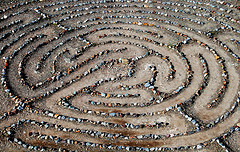 For
the past few days, I’ve been busy helping to build a labyrinth. My
awesome friend Chris Brandt, master coach and landscape design artist,
came and spray-painted an ancient pattern onto a 40-foot circle of earth
under some huge oak trees near my house, and then everyone got busy
finding rocks to mark the pattern as the rain washed it away. We put a
statue of Kuan Yin, an ancient Chinese goddess representing compassion,
at the entrance to the labyrinth. It’s like a gigantic human brain, all
folded into itself.
For
the past few days, I’ve been busy helping to build a labyrinth. My
awesome friend Chris Brandt, master coach and landscape design artist,
came and spray-painted an ancient pattern onto a 40-foot circle of earth
under some huge oak trees near my house, and then everyone got busy
finding rocks to mark the pattern as the rain washed it away. We put a
statue of Kuan Yin, an ancient Chinese goddess representing compassion,
at the entrance to the labyrinth. It’s like a gigantic human brain, all
folded into itself.I told a friend about this on the phone and she said, “I know how to solve those. You just keep your hand on one wall, and you’ll find your way out.” She thought I meant a maze. This is how our culture sees things: you’re in a place full of tricks and blind alleys, but if you’re clever enough, you’ll “solve” it and get out. That’s not what a labyrinth is. It’s a path you walk as a kind of meditative practice. You could walk out of it at any time, but you follow the patterns at your feet while releasing the patterns in your mind. Walking labyrinths is an ancient custom. Now I know why. I’ve walked my own labyrinth just a few times, and its curving lines have taken me straight to the truth about the way I live my life.
About halfway through my first walk, I found myself feeling terrified and angry. My thoughts went something like this: “This is such a waste of time. What am I doing here? I was two feet away from here before, now I’m doubling back for no reason—where is this taking me? What’s the goal? I can get there faster than this if I just jump….” on and on, ad nauseum.
As every life coach knows, the way we do anything is the way we do everything. The same thoughts that make me squirm in the labyrinth torture me when I’m writing, emailing, even sleeping. I should be going faster, getting somewhere. I should have more to show for this. I shouldn’t have to double back, to revisit old emotional issues, to wipe the same damn kitchen counter every day. These thoughts burble along just under the surface of my consciousness every day. They make me slightly anxious—okay, some days irrationally terrified—and lend a driven quality to moments when I could be relaxed and present.
I’ve heard the same comments from countless people, all schooled to the same obsession with forward progress. We set goals, draw flowcharts, march forward, criticize ourselves if we have to go back, if the same old stuff comes back to haunt us. We want to be DONE with things: the chronic pain, the haunting doubt, the bad relationship patterns, the grief of loss. We want to solve the maze and get out, to the place where we imagine there will be no problems to solve.
The labyrinth is teaching me to question the bits of driven, linear, achievement-based dysfunction that can make me miserable in a life of incredible blessings and good fortune. We didn’t enter life to get it done. There is no place not worth revisiting. We double back to find the pieces of ourselves that still clutch the same issues like a baby clutching its pacifier. Compassion invited us to this unbearably repetitive, slow, complex path of self-discovery, to show us that only when we surrender our idea of how things should be going do we notice that the entire thing is breathtakingly beautiful.
My loved ones and I are still building the labyrinth. Our land is not particularly rocky, so we’ve become obsessed with rocks the way a teenage starlet is obsessed with shopping. We cruise slowly past areas of nearby roads marked with “falling rock” warning signs, then stop the car, heave a few mini-boulders into the car, and speed off feeling the joy of acquisition. We have a goal (finish the labyrinth), we have a process (find rocks and arrange them), and the sense of purpose that comes with that is so familiar, so comfortingly linear. But in the end, what we’re building is a circuitous, contemplative, enfolded path that teaches us to be comfortable with the circuitous, repetitive, contemplative aspects of our lives.
Today, if you’re confronting an issue for the ten thousandth time, or feeling that your life is going nowhere, or panicking over how little you’ve achieved, stop and breathe. You’re not falling behind on some linear race through time. You’re walking the labyrinth of life. Yes, you’re meant to move forward, but almost never in a straight line. Yes, there’s an element of achievement, of beginning and ending, but those are minor compared to the element of being here now. In the moments you stop trying to conquer the labyrinth of life and simply inhabit it, you’ll realize it was designed to hold you safe as you explore what feels dangerous. You’ll see that you’re exactly where you’re meant to be, meandering along a crooked path that is meant to lead you not onward, but inward.
As Proust wrote, “The real voyage of discovery consists not in seeking new landscapes but in having new eyes.” Stop now, right now, and look around you. This is your place in the labyrinth. There is no place else you need to be. See with eyes that aren’t fixed on goals, or focused on flaws. You are part of the endless, winding beauty. And as you learn to see the dappled loveliness of your life, as your new eyes help you begin loving the labyrinth, you’ll slowly come to realize that the labyrinth was made solely for the purpose of loving you.
Inside Out movie reviews
Imagine a movie that talks about the brain and emotions.
How wnderful would that be.
I'm just waiting for the movie.
Here are some reviews.
http://medicalxpress.com/news/
http://time.com/3925611/
How wnderful would that be.
I'm just waiting for the movie.
Here are some reviews.
http://medicalxpress.com/news/
http://time.com/3925611/
Subscribe to:
Posts (Atom)