Showing posts with label life. Show all posts

Monday, May 4, 2020

This life is bad

This life is bad.
Many many mornings I wake up this way.
Feeling, life is just too unfair.
Some of the simplest things in life, have been denied to me.
And I have been a very hard working and conscientious person.
I have been dealt such a bad card in life.
Some simple pleasures denied.
There is truly no impetus to continue.
This life,...is bad,, bad ..bad..
I cant even tell anyone.
People always say 'be grateful. XYZ ke saath yeh huwa. ABC ko yeh huwa.
You have a family. You have this. you have that. Celebrate life. Be grateful.'.

I do have perspective. I am not blind.
But, where I am, feels bad. I am STUCK.
I am trying and trying. No luck.
Somewhere I shud have had some luck.

There is no enthu to participate.
I do try to cheer up and do things.
But joy evades me.
Peace, yes I have.
But no joy.

I try this and that. In an attempt to feel alive.
And in those outings I find a few addictions. A good movie/ series / book kindles that warmth in the heart. Makes me long. Makes me wish. And for days and months I warm myself in that addictive, illusory hearth. Living a life of fantasies, entirely in my head.

And then, regret catches up. And I try hard again to study something. Write something.
And I have no direction.  Broadly I feel I shud work towards becoming a writer.
I do read and research.

People scold me for lack of discipline and consistency.
But I don't think those are issues.
The conditions are unfavourable.
If someone's life condition is forever unfavourable, it's tough.
Sometimes you need some stroke of luck. You cannot be swimmimng upstream always.

When I see simple things like, so much hairfall, the possibility of going bald.
the way my body behaves (I've been trying to be disciplined with food) but not much help from inside...It's difficult to find clothes to wear. The simplest joys of being able to wear a nice dress, look nice are taken away from me.

The simple joy of looking in the mirror and feeling beautiful.
The simple joy of feeling your body agile and fit and strong.
The simple joy of doing some work that brings in money and compliments.
The simple joy of loving every contour of your body.
The simple joy of romance; sex; intimacy; orgasm.
The simple joy of beholding a baby.

I ask god for help. Everyday.
Some signs. Some whispering in the ear.
Some good news. Some progress somewhere.

For years.
No response.
Most often I feel, I have reached a point of no return.
I do not see anything bright, worth living for.
I feel cursed. Bad curse.
I feel I can never be happy ever.
I can never feel satisfied with such bad cards.

I feel it's time to call it quits. Hope for better cards in the next reincarnation.
A better behaved body. So that I can dress up, Look nice.
A disciplined mind.
Clarity and confidence from a young age.
Well formed habits.
Courage, consistency, rigour, right attitude - all pillars for success.
I want to live like a queen.

I think it's time to call it quits. I hope he takes me away quickly without pain.
I see no hope. I am just being a burden on the planet.
No amount of spiritual reading, mental consolation, positive thinking can take away from the fact that deep inside I feel cursed. Doomed. Stuck.
I see no hope ever. Of things changing. Of better days.

It's better to hit the restart button.

Tuesday, June 23, 2015

Labyrynth of Life - Martha Beck

http://marthabeck.com/2013/03/the-labyrinth-of-life/

The Labyrinth of Life… Insight from Martha

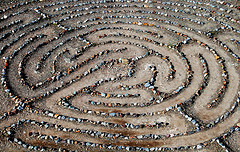
For the past few days, I’ve been busy helping to build a labyrinth. My awesome friend Chris Brandt, master coach and landscape design artist, came and spray-painted an ancient pattern onto a 40-foot circle of earth under some huge oak trees near my house, and then everyone got busy finding rocks to mark the pattern as the rain washed it away. We put a statue of Kuan Yin, an ancient Chinese goddess representing compassion, at the entrance to the labyrinth. It’s like a gigantic human brain, all folded into itself.
I told a friend about this on the phone and she said, “I know how to solve those. You just keep your hand on one wall, and you’ll find your way out.” She thought I meant a maze. This is how our culture sees things: you’re in a place full of tricks and blind alleys, but if you’re clever enough, you’ll “solve” it and get out. That’s not what a labyrinth is. It’s a path you walk as a kind of meditative practice. You could walk out of it at any time, but you follow the patterns at your feet while releasing the patterns in your mind. Walking labyrinths is an ancient custom. Now I know why. I’ve walked my own labyrinth just a few times, and its curving lines have taken me straight to the truth about the way I live my life.
About halfway through my first walk, I found myself feeling terrified and angry. My thoughts went something like this: “This is such a waste of time. What am I doing here? I was two feet away from here before, now I’m doubling back for no reason—where is this taking me? What’s the goal? I can get there faster than this if I just jump….” on and on, ad nauseum.
As every life coach knows, the way we do anything is the way we do everything. The same thoughts that make me squirm in the labyrinth torture me when I’m writing, emailing, even sleeping. I should be going faster, getting somewhere. I should have more to show for this. I shouldn’t have to double back, to revisit old emotional issues, to wipe the same damn kitchen counter every day. These thoughts burble along just under the surface of my consciousness every day. They make me slightly anxious—okay, some days irrationally terrified—and lend a driven quality to moments when I could be relaxed and present.
I’ve heard the same comments from countless people, all schooled to the same obsession with forward progress. We set goals, draw flowcharts, march forward, criticize ourselves if we have to go back, if the same old stuff comes back to haunt us. We want to be DONE with things: the chronic pain, the haunting doubt, the bad relationship patterns, the grief of loss. We want to solve the maze and get out, to the place where we imagine there will be no problems to solve.
The labyrinth is teaching me to question the bits of driven, linear, achievement-based dysfunction that can make me miserable in a life of incredible blessings and good fortune. We didn’t enter life to get it done. There is no place not worth revisiting. We double back to find the pieces of ourselves that still clutch the same issues like a baby clutching its pacifier. Compassion invited us to this unbearably repetitive, slow, complex path of self-discovery, to show us that only when we surrender our idea of how things should be going do we notice that the entire thing is breathtakingly beautiful.
My loved ones and I are still building the labyrinth. Our land is not particularly rocky, so we’ve become obsessed with rocks the way a teenage starlet is obsessed with shopping. We cruise slowly past areas of nearby roads marked with “falling rock” warning signs, then stop the car, heave a few mini-boulders into the car, and speed off feeling the joy of acquisition. We have a goal (finish the labyrinth), we have a process (find rocks and arrange them), and the sense of purpose that comes with that is so familiar, so comfortingly linear. But in the end, what we’re building is a circuitous, contemplative, enfolded path that teaches us to be comfortable with the circuitous, repetitive, contemplative aspects of our lives.
Today, if you’re confronting an issue for the ten thousandth time, or feeling that your life is going nowhere, or panicking over how little you’ve achieved, stop and breathe. You’re not falling behind on some linear race through time. You’re walking the labyrinth of life. Yes, you’re meant to move forward, but almost never in a straight line. Yes, there’s an element of achievement, of beginning and ending, but those are minor compared to the element of being here now. In the moments you stop trying to conquer the labyrinth of life and simply inhabit it, you’ll realize it was designed to hold you safe as you explore what feels dangerous. You’ll see that you’re exactly where you’re meant to be, meandering along a crooked path that is meant to lead you not onward, but inward.
As Proust wrote, “The real voyage of discovery consists not in seeking new landscapes but in having new eyes.” Stop now, right now, and look around you. This is your place in the labyrinth. There is no place else you need to be. See with eyes that aren’t fixed on goals, or focused on flaws. You are part of the endless, winding beauty. And as you learn to see the dappled loveliness of your life, as your new eyes help you begin loving the labyrinth, you’ll slowly come to realize that the labyrinth was made solely for the purpose of loving you.

Friday, February 27, 2015

Major changes coming up

I confess to being a little bit of a Shiva devotee. Shiva happens to be Sadhguru's muse and is the Adiyogi. So, this Mahashivarathri I stayed up till 5 am and no migraines the next day! Surprise surprise.. And I decided that enough is enough. I've damaged myself enough and I donno if it can be fixed this lifetime. I have no clue when it started, etc. But I know that I have this huge undercurrent of depression. There are days when I am barely functioning. So no 1 on the priority is to debug and fix this issue. Lots of other things can wait...

I think top priority is to not create any more fear and negativity. Every day should be full of positive experiences. When depression sprouts its head, chop it mercilessly. It hasn't helped one bit.
It's far more easy to just "do work", not overthink and progress atleast a mile - than sitting and worrying why we didn't do the ultra marathon. A mile walked in much better than dreaming about doing a marathon and not taking even one step out of bed. A little progress is so valuable.
Everyone installs tricks and habits to chop off the demons and we're not alone. We need to just be smart and install the right tricks for the right demons. 

Last 2 days I have got a huge collection of wonderful articles. Something really hit me in the head.
Something shook me out of my slumber and made me realize that let's make some progress atleast and acknowledge when that progress happens.

I read about resistance and how it attacks just about everyone.
I read about homeostatis and comfort zone.
I read a bit about depression.
I read about self doubt and how it kills creativity and passion and sucks your energy.
It's fear in different forms - all fear is fear of death and criticism.. a hyper sensitive ego at work.
I read about deliberate practice and professionals.

Your purpose may change with time.Priorities may change.

I realized how we create comfort coccoons and stay there. When you're in the coccoon you only survive. You do not grow.

The people who excelled - excelled by conquering their fears, not because they were made of a different mould.

People struggle through their lives to find their passion and meaning and I think the obstacles that this journey brings, if cleared properly, will peel off layer after layer of untruth.. When you peel these layers, one fine day, you're left with the truth. The truth is the same for all of us. When we reach that state, our work becomes art. It shines truthfully.It's genuine. Only when we become free of all fears and false beliefs and prejudices - we can truly produce great work.. genuine work. Till then the work is coloured by our fears - our illusions - it smacks of what others want and what you think others want or will appreciate. That's not genuine. You sometimes compromise but you finally do what your heart desires and hope that it goes down well with the world. Else, to hell with the world.

It also made me realize that we set our obstacles. When we conquer them, one thing is taken away from our plate. Maybe the whole concept of time is linked to our attainment of that one state. Then, like the sages say, time either vanishes or whatever...

It’s a lesson Rahman learnt early on in life. “Problem is, people compromise. Until something is not there, people won’t know it is there. So you have to create that wanting.” But getting people to want something they don’t know about isn’t easy. It takes time and patience: “First, you cater to what people need. Once you’ve done that, you compose what you love and believe people will love as well. And you stand by it, even at the risk of being rejected.” And how do you do that? “You can only be what you are. You can only try to maximise what you are. Good-looking or bad-looking, this is my shape; it is there for people to see. There is a beautiful quote that says, ‘I can never change what or how I look. But I can change how the world looks at me.’”


Brian Johnson's philosopher's notes on The war of art and The meaning of life.
http://brianjohnson.me/philosophersnotes/

http://www.copyblogger.com/creativity-killers/
https://www.americanexpress.com/us/small-business/openforum/articles/8-ways-highly-successful-people-overcome-self-doubt/

http://gailbrenner.com/2014/01/is-your-comfort-zone-really-that-comfortable/

http://www.mollygordon.com/overcome-fears-anxiety/maintaining-homeostasis.html

http://www.stevenpressfield.com/2013/11/resistance-and-self-loathing/

http://www.stevenpressfield.com/the-war-of-art/#book-top

http://jamesclear.com/deliberate-practice

http://jamesclear.com/required-for-success

http://jamesclear.com/professionals-and-amateurs

http://forbesindia.com/article/recliner/ar-rahman-and-the-art-of-focus/32584/0
(AR Rahman on focus).

http://www.thehindu.com/features/friday-review/ar-rahman-story-behind-jai-ho/article6937113.ece
It's interesting how he pays attention to every detail.
“The way he amalgamates South Indian sounds with Western classical music is something special. Dholak and pakhawaj sound different in his music. The way he hears the sounds around him is unique.
“Rahman is somewhat like a powerful radio tuned in to different corners of the world. He’s aware of every musician, every recording artist, every trend, every instrument. So when he composes, he draws on this knowledge base and analytical acumen and he also assembles exactly the right team for each piece he creates, down to even such minutiae as getting the right diction for a particular song, the dialect, the flavour,” .
It was also interesting to learn that while travelling he watches films in the silent mode, imagining the soundtrack rather than letting it play.

https://www.youtube.com/watch?v=6Y5AoZb4eGQ
(Harsha Bhogle's awesome IIM speech).

and also
https://enjoyingyourkids.wordpress.com/2015/02/26/i-am-lucky-to-be-a-stay-at-home-mom-sahm/
(Who decides which is most worthy and important?)

I also read about some books:

Buddha's Brain: The Practical Neuroscience of Happiness, Love, and Wisdom 

Hardwiring Happiness.

Do the work

The war of art.

And some pdfs from Dr Rick Hanson's page.


http://www.huffingtonpost.com/2013/10/17/how-tiny-joyful-moments-c_n_4108363.html?ir=India

http://greatergood.berkeley.edu/resources/slide_presentations

Thursday, January 15, 2015

Tending to your inner garden and healing

From brainpickings.
Rainer Maria Rilke
 Rilke on What Winter Teaches Us about the Riches of Life and the Tenacity of the Human Spirit
Tending my inner garden went splendidly this winter. Suddenly to be healed again and aware that the very ground of my being — my mind and spirit — was given time and space in which to go on growing; and there came from my heart a radiance I had not felt so strongly for a long time… You tell me how you are able to feel fully alive every moment of the day and that your inner life is brimming over; you write in the knowledge that what you have, if one looks at it squarely, outweighs and cancels all possible privations and losses that may later come along. It is precisely this that was borne in upon me more conclusively than ever before as I worked away during the long Winter months: that the stages by which life has become impoverished correspond with those earlier times when excesses of wealth were the accustomed measure. What, then, is there to fear? Only forgetting! But you and I, around us and in us, we have so much in store to help us remember!
Philosopher Joanna Macy’s soul-gladdening A Year with Rilke: Daily Readings from the Best of Rainer Maria Rilke — which also gave us Rilke’s magnificent letters on how befriending death helps us live more fully — includes an excerpt of this letter, translated by Macy herself thusly:
You might notice that in some ways the effects of our winter experiences are similar. You write of a constant sense of fullness, an almost overabundance of inner being, which from the outset counterbalances and compensates all deprivations and losses that might possibly come. In the course of my work this last long winter, I have experienced a truth more completely than ever before: that life’s bestowal of riches already surpasses any subsequent impoverishment. What, then, remains to be feared? Only that we might forget this! But around and within us, how much it helps to remember!
In his final letter to Heise in February of 1924, by which point she had gotten back on her feet, Rilke echoes this faith in the tenacity of the human spirit and our resilient capacity for joy. Needham’s translation:
Do you not have an increasing sense that underlying one’s own preparedness to accept whatever fate may bring there is a warm, sincere, frightened yet daring unchangeability? And what does living come down to but bringing about those changes in ourselves which we have daringly attempted and which can free us to enjoy a richness and closeness with everyone? After so much honest progress you have now come thus far: that you can live humbly and with the clear expectation that nothing untrue will, nor indeed can, ever find its way in to your heart, for you have that voice within you which merits your safe trust, your utmost faithfulness, and your joy.

Thursday, December 11, 2014

What drives you?

What drives you:
The part about boredom is so damn true for me!
I've always wondered what is it that makes people wake up from bed every morning. How do they get up to monotonous jobs? What gives them the energy to get through a day? Certainly not caffeine.

Osho said that broadly people are motivated by three things: money, power, sex.
Maybe most things are a manifestation of these.

http://www.calmdownmind.com/what-are-you-driven-by/

Driven by Boredom – To be driven by boredom is an evolution on being driven by hatred or fear, this is like a state of “peace” where you’ve mostly just surrendered to life. You’ve no energy to fight against anything, you don’t essentially find any strong meaning in anything, you are not passionate towards anything. There is peace, but there is also a sense of deep dullness and detachment which looks “spiritual” externally. A lot of people mistakenly take this state to be the “enlightened” state, mostly because a person in this state is quite unaffected by anything. It’s true, however, that there is a lot of wisdom in this state, the dimension of boredom is an opening towards connecting you with the intelligence of your life-stream. One has a much clearer view on life and can see through a lot of unconscious mind games. However, this sense of meaninglessness starts building up slowly to the point of a subtle, or even strong, depression within. This sense of dullness eventually builds to a point where it pushes you towards an expression that involves some passion.
Driven by Sexuality – To be driven by sexuality is the start of connecting with your body in the sense of finding joy in it, so it’s a gateway towards the higher vibration of life, towards your source nature. Sexuality, in its pure form, is free of fear or hatred, it’s a powerful vibration of its own, and it’s definitely a very passionate driving force that takes you out of the motivation of boredom. The wisdom garnered from the state of boredom, the fearlessness and lack of hatred garnered from the previous growth, allows one to have a very free expression of sexuality. All the repressed sexual drive can come flooding onto the surface creating an almost drugged state of lust. It’s possible to be driven by this state for long time, mostly because of its intensity, its higher vibration, sense of detachment, lack of negativity and the “feel good” factor. However, with time, there is a natural progression towards being driven by sensuality as much as sexuality as a more evolved state of being.

Driven by Joy – Sexuality and sensuality are adjacent to each other, and there is as much an indulgence in sensuality as sexuality, in this place. By sensuality I mean being driven by the senses, drinking in the sensory pleasures of sight, taste, smell, touch – enjoying the aliveness of life, the adventure of living and the vivaciousness of joy-based action. Such a life may seem very superficial from the outside, especially to people who are driven by fear, hatred or boredom, but in truth it’s a huge evolution and is very close to the vibration of source. When one is consciously driven by joy one is at a high state of evolution because in this place one is not influenced by negativity of any form, the mindset of struggle is completely done away with – it’s not possible to influence such a person in any negative manner.
There is close to zero motivation to ever grow from this place, it seems to have everything but it’s not long (by long I mean it could be a few months, few years or a few lifetimes) before one sees through the limitations of joy. It comes as an unavoidable realization that joy is still missing something, it’s a highly disconcerting thought initially and the mind makes several attempts at distraction, trying to cover it up with joy-based activities as much as possible, but once the realization comes in it just doesn’t go away no matter how hard you try to avoid facing it. In this place, for a while, there can be a sudden influx of hatred, fear, boredom all at once because of the disorientation the mind feels – it almost feels like a total regression, like falling back in evolution, but this disorientation is very temporary mostly because your understanding of life is pretty evolved by now and hence is not stuck in any of the low states for long. However, joy stops being the motivating force anymore, once this realization sets in, and neither is hatred, fear, boredom or sexuality – if you allow this confusion fully you will naturally move towards the next phase of growth.
Driven by Love – There is a lot of misunderstanding about love mostly because it’s always corrupted by fear, hatred, joy, or even sexuality, in some way. Fear-based love is tainted with worry, hated-based love is tainted with jealousy/possessiveness, Sexuality-based love is tainted with an insensitive lust, joy-based love is also a lot of frolic with a missing sensitivity. When you’ve consciously evolved from fear, hatred and the primal force of sexuality, and you’ve seen through the limits of joy, you are finally mature enough to sense what “true love” really is. This love is not necessarily “towards” anything or anyone, this love is a state of being, it’s like a final resting place where you feel like yourself more than anything else. Of course, you can have specific love for someone, or something, from this place, but its presence in you is not dependent on any outside influence – it’s not like if the object of love is removed you will go into depression, you will still be in the same place of love, because this love is a state of being not an experience.
As a human being this is the highest evolution you can reach and from here on it’s just expression, just like source is always expressing itself in some form or the other. You feel driven everyday by this love, it’s “causeless”, it has no reason, it just drives you because it’s who you are. In this place you realize why life can’t help but express itself, why it creates the myriads of forms in nature, it’s driven by this true love. There is nothing more amazing than for this life-energy to come back to this realization of its true nature, again and again, in the form of different streams of consciousness with different journeys. This state of “true love” can be called different names – inner wholeness, a state of balance, inner stability, happiness, but ultimately it’s something you need to live to know what it is, words really can’t explain it clearly enough and there are so many misunderstandings possible. The best one can do is to use words as a pointer towards allowing this natural growth, this pull towards growth is already ever-present in all of us.

Evolution in a lifetime

Some of us will go through this whole sequence, mentioned above, in one lifetime, possibly even in a period of a few months, to a year. This just means that your journey this far made you ready, and receptive, for a quick transition between the states. Some may find it difficult to make a transition in spite of gaining an understanding and it’s fine, it just means it will take some more time and more experience. You can only transition when you are ready. Unless you experience all the “driving factors” and see their limitations you cannot come to a final rest in true love, it happens only when the mind really experiences this realization. This is not a directive to be forced on the mind, it’s just a pointer to help the mind understand the path of growth so that it’s not unconsciously holding on to any state out of confusion.

If you are willing to be open enough to drop an old “driving force”, just this receptivity is enough for your life-stream to instigate a growth. It’s when we try to cling to our past driving force, because we try to gain some sense of identity from it, that it becomes difficult to allow growth until it reaches a point of desperation where there is no choice but to grow or perish in someway. As I mentioned in this post – An attitude of learning – the best attitude to have towards life is to see everything as an opportunity for inner growth, in many cases growth comes in the form of some suffering especially from a sense of disorientation or failure. I don’t see anything as negative, I can only see a value towards growth in everything and this attitude is what really allows me to be resistance-free towards allowing the growth intended through any situation or thought.

Monday, December 8, 2014

Whose success is it anyway and is it worth the price?

The last few days I have been musing about what really is this thing called "success"?
What is this quest to find one's passion?
Does success bring happiness always?
Is our own success overshadowed by someone else's success?

Are these severely over-rated terms?
Have they destroyed what we could have been?

All of us chase success and happiness. Given that, we need to deeply introspect as to how we define success in the first place. So many of us are probably "successful" but because our definition of success is flawed, we're either choking in self pity or oblivious to the fact that we are actually successful and it calls for a celebration.

If it can be safely assumed that man acts according to his deeply ingrained beliefs - I think that is where the trouble starts to brew. These beliefs or goals or value systems or moral framework get set right from the day one is born.

It is such a surreptitious process that one is not aware that our future is going to be so screwed. So, when you reach your 30s (most probably, for most people atleast) you wonder where you're headed. Almost everyone feels lost. Probably this is what is called midlife crisis. There's no trophy to run for. Life looks a little easier when there are trophies to run for. This would explain why a housewife feels very listless compared to a working woman. One has tangible goals - goals accepted by all and is chasing it. The other doesn't have such tangible goals and hence the pursuit and achievement of goals is a little less rewarding for many though that person is probably very successful and has every cause of celebration. Just the absence of goals or the aspiration for standardized goals can lead to desperation.

A very accomplished photographer posted a very disturbing post on FB.
"I'm 40 and I still wonder what my passion is!".If this person, who, has pursued photography all along and has achieved numerous awards and recognition, feels this way, where does it leave the rest of us?

Then there are the countless movies where an ordinary guy becomes hugely successful and earns the respect of his family and society. What if he was not "that" successful? We usually see movies where the struggling protagonist wins an award or gets into IIM or meets the President of India or becomes the best artist. Anything less than the first rank is not portrayed usually.

Thus, we have been constantly "fed" images of success. There are numbers associated with success. There is fame and recognition tied with the most common definitions of success. We all have bought those definitions sub-consciously and we're chasing those definitions. No wonder then that many of us do feel disappointed and vexed.

The next common myth is the "I need to find my passion" myth. I'm not sure how it happens with most people. How do you know when it happens? If you're pursuing something and you're happy with it, what makes you doubt that it may not be your passion? This singular quest has killed so many humans.While searching I hit upon this article, which almost precisely states the same thing. "precisely how you arrive at your true calling is an intricate and highly individual dance of discovery." How do we find that this is our true calling? It's a combination of things, it's a huge discovery in itself and you may have to stumble multiple times before you hit that jackpot.
http://www.brainpickings.org/index.php/2012/02/27/purpose-work-love/

At this juncture, some people's views may help us wade through the muddiness.
Alan Watts's  - "Find one's natural rhythm and feel the eternal in your bones."
Prof Mihaly's flow state - "people are happiest when they are in a state of flow— a state of concentration or complete absorption with the activity at hand and the situation. It is a state in which people are so involved in an activity that nothing else seems to matter."

These could be good starting points but again, these are someone else's definitions :-)


Then there are many super successful people who quit the jobs that made them successful - because they did not find meaning in them. If such stupendous success is devoid of meaning, what is the use of pursuing success? Why chase success and money? http://articles.economictimes.indiatimes.com/2013-04-19/news/38648128_1_microsoft-india-identity-work

I wonder if these are over-rated things. Is success the goal in life? Does success guarantee happiness?
If so many successful people leave their successful jobs or even contemplate suicide, why are the rest chasing such success? 

Another worrisome ingredient to the already confusing topic of success is - is success sweeter in comparison? Do we get a sense of self and "success" by comparing with others?
http://www.sadhguruonline.com/podcasts/living-free-of-comparison
Does our success feel less successful because it's not as glamorous as someone else whom we know?
Do most of us belittle ourselves all the time because we do not match someone's standard of success?
I can see this happening to a lot of people nowadays.

Constantly existing here in comparison with anyone else and feeling happy simply because you have what others don't - is such a poor way to live. - Sadhguru.
“Constantly existing here in comparison with anyone else is an insult to your Creator.” —Sadhguru - See more at: http://www.sadhguruonline.com/podcasts/living-free-of-comparison#sthash.qlEI2QZx.dpuf

“Constantly existing here in comparison with anyone else is an insult to your Creator.” —Sadhguru - See more at: http://www.sadhguruonline.com/podcasts/living-free-of-comparison#sthash.qlEI2QZx.dpuf

Today I read about Uber being a 40bn dollar company and a relatively unknown shared cab service in Gaza.
http://www.theguardian.com/world/2014/dec/07/gaza-young-entrepreneurs-web-based-startups
What if that woman felt less of herself comparing her revenues to Uber's success? You never know. So often we see a common man's success completely being overshadowed by someone else's. This world is certainly not the easiest place to navigate!

One specific term to bring up, when we talk of comparison, is the word "mediocre". I want to kill that word. Whoever coined that - did you know that this word has led to the death of countless fabulous human beings?

"Salieri was a hard working musician but he could never transcend mediocrity. Mozart's presence was a constant reminder of what he could never be. He vowed to destroy Mozart."
What Salieri would have actually done is - kill himself in that course. He killed Salieri to become Mozart. Why Oh Why.. Why this term? A person is mediocre only when he's not done his personal best. If he's given his best but his best is different from Mozart's best, it's not his fault. In your appraisal you can be at the bottom of a bellcurve but you need to have the maturity to understand that it's not you who's mediocre. Your specific skill in comparison to a lot of others, is ranked that way and it should be fine. It should not cause sadness or humiliation or depression.

Mediocre today means comparison - relational operator. How can a person become a thing to be compared?
I'm not saying that I am a saint who never felt mediocre. I am a victim of not having understood that term. But after I started reading Osho and Sadhguru and others I came to know what they meant. I understood a little more about jealousy and comparison. I understood that my path and goal and unique to me. I cannot share it with others. Parts of the journey and feelings I can share, not the entire one. I have very occasional pangs of jealousy when I see someone excelling in the creative field, but even then I totally understand that they come with different talents and so there is no question of comparison. And I feel that this whole fan-dom is wasting my time. When we become someone's fans, we internally aspire to become them. That maybe doing a lot more harm to us.

Most people spend their lives trying to become like someone else. The constant comparing and aspiring to be someone different, the need to be one up on somebody, just wastes the fundamental possibility in a human being. 

The following is an awesome compilation of articles regarding jealousy and comparison.
http://www.ishafoundation.org/blog/sadhguru/masters-words/living-free-of-comparison/
http://www.osho.com/read/featured-articles/other-myself/what-is-jealousy-and-why-does-it-hurt-so-much
http://mindofnature.wordpress.com/2014/07/16/osho-on-uniqueness-and-comparison/

How you are should never be determined by how someone else is. If you allow that, you will be a slave to that someone. Sadhguru

A human being need not be useful. If he or she blossoms into a full-fledged human being, that is good enough. Sadhguru

The key points in these articles is:
- you have not allowed your own juices to flow.
- You know your inside, and you know the others’ outside: that creates jealousy.
- Because you have not developed your inner treasures, you feel jealous of others.
- Spend your entire life finding your abilities - then transcend them.

Also, as a parallel, we have UT prof Raj talk about similar things and this is research based evidence.
http://happysmarts.com/how-negative-is-your-mental-chatter/

"Our mental chatter is rooted in goals and values to which most of us blindly subscribe. As such, it’s not surprising that our thoughts revolve around inferiority, love, and control. For example, most of are brought up to succeed and excel in life; as a result, we are habituated to comparing ourselves—in terms of our skills, talents and endowments—with that of our peers, which generates inferiority-related thoughts. I find it interesting that the very things that most of us believe to be the means to happiness—a sense of superiority over others, finding our true love, and gaining control—ultimately undermine it.
I wonder whether people’s negative mental chatter would turn positive if they stopped pursuing superiority, love and control. This is an idea that’s certainly worth exploring. "


The problem is, these thoughts happen subconsciously. These comparisons.. this not living it up.. not upto the mark.. all these comparisons happen at such a terrifying speed that we ourselves don't know when they happen and most importantly how such thoughts happen. Years of exposure to success, the trophies, the medals, the award ceremonies, the magazines, newspapers, the sexiest woman alive tags, Entrepreneur of the year, 100 most promising tech startups,.....have seeped into us. Years of exposure have altered the subconscious programming.

Now that we've spoken enough about success, what is the seed whose flower is success? Aspirations or desires or dreams or ambitions. How are our ambitions shaped? Are our desires our own? The media portrays so many fields as glamorous and unknowingly we tend to dream about them. So many millions want to make it as film stars. It may not be their real destiny. It's due to the glamour associated with that world that so many like it. So is it with technology or nowadays cooking. We don't evaluate so thoroughly our choices and interests. We get carried away and make choices that are not meant for us. It need not be a big decision like career - even small things like - how you want to dress, what kind of woman you want to be - are all determined by the society in which you grow up. A friend of mine recently said that if I'd been a Punjabi and she'd been a Tamilian - we both would have been considered very successful women! We just had to swap spaces to feel successful because the way our own society definied successful or intelligent women excluded us from competition.

Alain De Botton's pearls of wisdom here about how important it is to have original, customized ambitions for ourselved - "One of the interesting things about success is that we think we know what it means. A lot of the time our ideas about what it would mean to live successfully are not our own. They’re sucked in from other people. And we also suck in messages from everything from the television to advertising to marketing, etcetera. These are hugely powerful forces that define what we want and how we view ourselves. What I want to argue for is not that we should give up on our ideas of success, but that we should make sure that they are our own. We should focus in on our ideas and make sure that we own them, that we’re truly the authors of our own ambitions. Because it’s bad enough not getting what you want, but it’s even worse to have an idea of what it is you want and find out at the end of the journey that it isn’t, in fact, what you wanted all along."

So, here is how together it all becomes a dangerous cocktail. Society/Media tries to set your dreams.
Society/Media defines success for you. How you should live, what you should buy, what kind of car to aspire for - these get programmed into you and you just become an earning tool which earns and spends. Your school, in all probability killed most of you. You were not even consulted before the code was inserted into you. You just execute that code to the benefit of a whole lot of businesses. Your dreams aren't yours. Your definition of success is flawed. You're blindly living a life - feeling lonely and empty many a times. What's yours is just the guilt and pain that you carry because of disappointment with yourself and you don't even know why you feel so low.

I was thinking yesterday that we need to bring up our kids without any definition of success..
I think the ultimate goal for a human is to flower and we all flower in unique ways. No two roses flower alike. We all require a little different composition of air, water, fire and earth.
Some of us grow in forests. Some of us at home. Some of us have good gardeners. Some of us grow on our own. Some of us need improvers to help us grow. Some of us can grow even in less sunlight. Some of us need less water. We're so genetically, culturally different. We come with different abilities but we all have the ability to discover ourselves and accept ourselves and lead very very fulfilling lives. I have seen such people too. People who love literature, people who love arts - who did not chase fame and success and settled into beautiful corners of the world to lead very "ordinary" lives - content lives.

I think whatever our age be, we should rewrite the definitions of life, success, etc. We need to break the old self and reconstruct a new one with new definitions of our own. Once the new definitions get absorbed in the subconscious through enough repetitions, I think the old ones will not hold us prisoners.


So, if we exist, as life, not as a product to be compared, we free ourselves. We liberate ourself so that we can discover who we are and do what we're meant to do. We need to have a new relation with ourself - a relation which is rooted in respect and love and acceptance. A relation where the chatter in the head is full of laughter and original aspirations. We need to relook our goals and beliefs and change many of them. We need to define what we want to be; what we want to do; what kind of life we want to lead and just follow that even if it doesn't make sense to any other human. By creating such an ambience inside our head - we can push ourselves to do more.. to treat ourself with love, to handle any disappointments with courage, to surpass ourself, to accept changes, to alter our goals if required and eventually lead fulfilling lives.

For me personally, I have reached a significant stage in my journey. A lot of basic things are falling into place. The ground is being readied for something to bloom.

========================================================================

I feel that a real living form is the result of the individual’s effort to create the living thing out of the adventure of his spirit into the unknown—where it has experienced something—felt something—it has not understood—and from that experience comes the desire to make the unknown—known. By unknown—I mean the thing that means so much to the person that wants to put it down—clarify something he feels but does not clearly understand—sometimes he partially knows why—sometimes he doesn’t—sometimes it is all working in the dark—but a working that must be done—Making the unknown—known—in terms of one’s medium is all-absorbing—if you stop to think of the form—as form you are lost—The artist’s form must be inevitable—You mustn’t even think you won’t succeed—Whether you succeed or not is irrelevant—there is no such thing. Making your unknown known is the important thing—and keeping the unknown always beyond you—catching crystallizing your simpler clearer version of life—only to see it turn stale compared to what you vaguely feel ahead—that you must always keep working to grasp—the form must take care of its self if you can keep your vision clear.

Whose success is it anyway and is it worth the price?

The last few days I have been musing about what really is this thing called "success"?
What is this quest to find one's passion?
Does success bring happiness always?
Is our own success overshadowed by someone else's success?

Are these severely over-rated terms?
Have they destroyed what we could have been?

All of us chase success and happiness. Given that, we need to deeply introspect as to how we define success in the first place. So many of us are probably "successful" but because our definition of success is flawed, we're either choking in self pity or oblivious to the fact that we are actually successful and it calls for a celebration.

If it can be safely assumed that man acts according to his deeply ingrained beliefs - I think that is where the trouble starts to brew. These beliefs or goals or value systems or moral framework get set right from the day one is born.

It is such a surreptitious process that one is not aware that our future is going to be so screwed. So, when you reach your 30s (most probably, for most people atleast) you wonder where you're headed. Almost everyone feels lost. Probably this is what is called midlife crisis. There's no trophy to run for. Life looks a little easier when there are trophies to run for. This would explain why a housewife feels very listless compared to a working woman. One has tangible goals - goals accepted by all and is chasing it. The other doesn't have such tangible goals and hence the pursuit and achievement of goals is a little less rewarding for many though that person is probably very successful and has every cause of celebration. Just the absence of goals or the aspiration for standardized goals can lead to desperation.

A very accomplished photographer posted a very disturbing post on FB.
"I'm 40 and I still wonder what my passion is!".If this person, who, has pursued photography all along and has achieved numerous awards and recognition, feels this way, where does it leave the rest of us?

Then there are the countless movies where an ordinary guy becomes hugely successful and earns the respect of his family and society. What if he was not "that" successful? We usually see movies where the struggling protagonist wins an award or gets into IIM or meets the President of India or becomes the best artist. Anything less than the first rank is not portrayed usually.

Thus, we have been constantly "fed" images of success. There are numbers associated with success. There is fame and recognition tied with the most common definitions of success. We all have bought those definitions sub-consciously and we're chasing those definitions. No wonder then that many of us do feel disappointed and vexed.

The next common myth is the "I need to find my passion" myth. I'm not sure how it happens with most people. How do you know when it happens? If you're pursuing something and you're happy with it, what makes you doubt that it may not be your passion? This singular quest has killed so many humans.While searching I hit upon this article, which almost precisely states the same thing. "precisely how you arrive at your true calling is an intricate and highly individual dance of discovery." How do we find that this is our true calling? It's a combination of things, it's a huge discovery in itself and you may have to stumble multiple times before you hit that jackpot.
http://www.brainpickings.org/index.php/2012/02/27/purpose-work-love/

At this juncture, some people's views may help us wade through the muddiness.
Alan Watts's  - "Find one's natural rhythm and feel the eternal in your bones."
Prof Mihaly's flow state - "people are happiest when they are in a state of flow— a state of concentration or complete absorption with the activity at hand and the situation. It is a state in which people are so involved in an activity that nothing else seems to matter."

These could be good starting points but again, these are someone else's definitions :-)


Then there are many super successful people who quit the jobs that made them successful - because they did not find meaning in them. If such stupendous success is devoid of meaning, what is the use of pursuing success? Why chase success and money? http://articles.economictimes.indiatimes.com/2013-04-19/news/38648128_1_microsoft-india-identity-work

I wonder if these are over-rated things. Is success the goal in life? Does success guarantee happiness?
If so many successful people leave their successful jobs or even contemplate suicide, why are the rest chasing such success? 

Another worrisome ingredient to the already confusing topic of success is - is success sweeter in comparison? Do we get a sense of self and "success" by comparing with others?
http://www.sadhguruonline.com/podcasts/living-free-of-comparison
Does our success feel less successful because it's not as glamorous as someone else whom we know?
Do most of us belittle ourselves all the time because we do not match someone's standard of success?
I can see this happening to a lot of people nowadays.

Constantly existing here in comparison with anyone else and feeling happy simply because you have what others don't - is such a poor way to live. - Sadhguru.
“Constantly existing here in comparison with anyone else is an insult to your Creator.” —Sadhguru - See more at: http://www.sadhguruonline.com/podcasts/living-free-of-comparison#sthash.qlEI2QZx.dpuf

“Constantly existing here in comparison with anyone else is an insult to your Creator.” —Sadhguru - See more at: http://www.sadhguruonline.com/podcasts/living-free-of-comparison#sthash.qlEI2QZx.dpuf

Today I read about Uber being a 40bn dollar company and a relatively unknown shared cab service in Gaza.
http://www.theguardian.com/world/2014/dec/07/gaza-young-entrepreneurs-web-based-startups
What if that woman felt less of herself comparing her revenues to Uber's success? You never know. So often we see a common man's success completely being overshadowed by someone else's. This world is certainly not the easiest place to navigate!

One specific term to bring up, when we talk of comparison, is the word "mediocre". I want to kill that word. Whoever coined that - did you know that this word has led to the death of countless fabulous human beings?

"Salieri was a hard working musician but he could never transcend mediocrity. Mozart's presence was a constant reminder of what he could never be. He vowed to destroy Mozart."
What Salieri would have actually done is - kill himself in that course. He killed Salieri to become Mozart. Why Oh Why.. Why this term? A person is mediocre only when he's not done his personal best. If he's given his best but his best is different from Mozart's best, it's not his fault. In your appraisal you can be at the bottom of a bellcurve but you need to have the maturity to understand that it's not you who's mediocre. Your specific skill in comparison to a lot of others, is ranked that way and it should be fine. It should not cause sadness or humiliation or depression.

Mediocre today means comparison - relational operator. How can a person become a thing to be compared?
I'm not saying that I am a saint who never felt mediocre. I am a victim of not having understood that term. But after I started reading Osho and Sadhguru and others I came to know what they meant. I understood a little more about jealousy and comparison. I understood that my path and goal and unique to me. I cannot share it with others. Parts of the journey and feelings I can share, not the entire one. I have very occasional pangs of jealousy when I see someone excelling in the creative field, but even then I totally understand that they come with different talents and so there is no question of comparison. And I feel that this whole fan-dom is wasting my time. When we become someone's fans, we internally aspire to become them. That maybe doing a lot more harm to us.

The following is an awesome compilation of articles regarding jealousy and comparison.
http://www.ishafoundation.org/blog/sadhguru/masters-words/living-free-of-comparison/
http://www.osho.com/read/featured-articles/other-myself/what-is-jealousy-and-why-does-it-hurt-so-much
http://mindofnature.wordpress.com/2014/07/16/osho-on-uniqueness-and-comparison/

How you are should never be determined by how someone else is. If you allow that, you will be a slave to that someone. Sadhguru

A human being need not be useful. If he or she blossoms into a full-fledged human being, that is good enough. Sadhguru

The key points in these articles is:
- you have not allowed your own juices to flow.
- You know your inside, and you know the others’ outside: that creates jealousy.
- Because you have not developed your inner treasures, you feel jealous of others.
- Spend your entire life finding your abilities - then transcend them.

Also, as a parallel, we have UT prof Raj talk about similar things and this is research based evidence.
http://happysmarts.com/how-negative-is-your-mental-chatter/

"Our mental chatter is rooted in goals and values to which most of us blindly subscribe. As such, it’s not surprising that our thoughts revolve around inferiority, love, and control. For example, most of are brought up to succeed and excel in life; as a result, we are habituated to comparing ourselves—in terms of our skills, talents and endowments—with that of our peers, which generates inferiority-related thoughts. I find it interesting that the very things that most of us believe to be the means to happiness—a sense of superiority over others, finding our true love, and gaining control—ultimately undermine it.
I wonder whether people’s negative mental chatter would turn positive if they stopped pursuing superiority, love and control. This is an idea that’s certainly worth exploring. "


The problem is, these thoughts happen subconsciously. These comparisons.. this not living it up.. not upto the mark.. all these comparisons happen at such a terrifying speed that we ourselves don't know when they happen and most importantly how such thoughts happen. Years of exposure to success, the trophies, the medals, the award ceremonies, the magazines, newspapers, the sexiest woman alive tags, Entrepreneur of the year, 100 most promising tech startups,.....have seeped into us. Years of exposure have altered the subconscious programming.

Now that we've spoken enough about success, what is the seed whose flower is success? Aspirations or desires or dreams or ambitions. How are our ambitions shaped? Are our desires our own? The media portrays so many fields as glamorous and unknowingly we tend to dream about them. So many millions want to make it as film stars. It may not be their real destiny. It's due to the glamour associated with that world that so many like it. So is it with technology or nowadays cooking. We don't evaluate so thoroughly our choices and interests. We get carried away and make choices that are not meant for us. It need not be a big decision like career - even small things like - how you want to dress, what kind of woman you want to be - are all determined by the society in which you grow up. A friend of mine recently said that if I'd been a Punjabi and she'd been a Tamilian - we both would have been considered very successful women! We just had to swap spaces to feel successful because the way our own society definied successful or intelligent women excluded us from competition.

Alain De Botton's pearls of wisdom here about how important it is to have original, customized ambitions for ourselved - "One of the interesting things about success is that we think we know what it means. A lot of the time our ideas about what it would mean to live successfully are not our own. They’re sucked in from other people. And we also suck in messages from everything from the television to advertising to marketing, etcetera. These are hugely powerful forces that define what we want and how we view ourselves. What I want to argue for is not that we should give up on our ideas of success, but that we should make sure that they are our own. We should focus in on our ideas and make sure that we own them, that we’re truly the authors of our own ambitions. Because it’s bad enough not getting what you want, but it’s even worse to have an idea of what it is you want and find out at the end of the journey that it isn’t, in fact, what you wanted all along."

So, here is how together it all becomes a dangerous cocktail. Society/Media tries to set your dreams.
Society/Media defines success for you. How you should live, what you should buy, what kind of car to aspire for - these get programmed into you and you just become an earning tool which earns and spends. Your school, in all probability killed most of you. You were not even consulted before the code was inserted into you. You just execute that code to the benefit of a whole lot of businesses. Your dreams aren't yours. Your definition of success is flawed. You're blindly living a life - feeling lonely and empty many a times. What's yours is just the guilt and pain that you carry because of disappointment with yourself and you don't even know why you feel so low.

I was thinking yesterday that we need to bring up our kids without any definition of success..
I think the ultimate goal for a human is to flower and we all flower in unique ways. No two roses flower alike. We all require a little different composition of air, water, fire and earth.
Some of us grow in forests. Some of us at home. Some of us have good gardeners. Some of us grow on our own. Some of us need improvers to help us grow. Some of us can grow even in less sunlight. Some of us need less water. We're so genetically, culturally different. We come with different abilities but we all have the ability to discover ourselves and accept ourselves and lead very very fulfilling lives. I have seen such people too. People who love literature, people who love arts - who did not chase fame and success and settled into beautiful corners of the world to lead very "ordinary" lives - content lives.

I think whatever our age be, we should rewrite the definitions of life, success, etc. We need to break the old self and reconstruct a new one with new definitions of our own. Once the new definitions get absorbed in the subconscious through enough repetitions, I think the old ones will not hold us prisoners.


So, if we exist, as life, not as a product to be compared, we free ourselves. We liberate ourself so that we can discover who we are and do what we're meant to do. We need to have a new relation with ourself - a relation which is rooted in respect and love and acceptance. A relation where the chatter in the head is full of laughter and original aspirations. We need to relook our goals and beliefs and change many of them. We need to define what we want to be; what we want to do; what kind of life we want to lead and just follow that even if it doesn't make sense to any other human. By creating such an ambience inside our head - we can push ourselves to do more.. to treat ourself with love, to handle any disappointments with courage, to surpass ourself, to accept changes, to alter our goals if required and eventually lead fulfilling lives.

For me personally, I have reached a significant stage in my journey. A lot of basic things are falling into place. The ground is being readied for something to bloom.

========================================================================

I feel that a real living form is the result of the individual’s effort to create the living thing out of the adventure of his spirit into the unknown—where it has experienced something—felt something—it has not understood—and from that experience comes the desire to make the unknown—known. By unknown—I mean the thing that means so much to the person that wants to put it down—clarify something he feels but does not clearly understand—sometimes he partially knows why—sometimes he doesn’t—sometimes it is all working in the dark—but a working that must be done—Making the unknown—known—in terms of one’s medium is all-absorbing—if you stop to think of the form—as form you are lost—The artist’s form must be inevitable—You mustn’t even think you won’t succeed—Whether you succeed or not is irrelevant—there is no such thing. Making your unknown known is the important thing—and keeping the unknown always beyond you—catching crystallizing your simpler clearer version of life—only to see it turn stale compared to what you vaguely feel ahead—that you must always keep working to grasp—the form must take care of its self if you can keep your vision clear.

Wednesday, November 26, 2014

Aging and living a rich life

I recently read "Tuesdays with Morrie". It was a simple, fascinating read. It spoke a little of love, death, aging and relations.
One of the thing that I really loved in it was - you want to go back in time just because you did not live it well enough. You're in your 20s and you think a lot about your teens or 30s. You live your 20s less. So, when you move on to your 30s you miss your 20s.

I loved that point. I already read that we are less and less inhabiting our bodies. We're less and less inhabiting the present moment.

http://www.brainpickings.org/tag/alan-watts/page/2/
http://www.brainpickings.org/2014/01/06/alan-watts-wisdom-of-insecurity-1/

Excerpts:

Indeed, my own New Year’s resolution has been to stop measuring my days by degree of productivity and start experiencing them by degree of presence. But what, exactly, makes that possible? This concept of presence is rooted in Eastern notions of mindfulness — the ability to go through life with crystalline awareness and fully inhabit our experience.

Nearly a century earlier, in his funny and wise reflection on feeding the mind, Lewis Carroll admonished that “mental gluttony, or over-reading, is a dangerous propensity, tending to weakness of digestive power, and in some cases to loss of appetite.” And yet, cut off from both our bodies and our brains, we constantly oscillate between distraction and mental gluttony, seething in a cauldron of our own making, unwilling or unable to still our minds long enough for the truly meaningful to settle and coalesce.

Analysis:
Why do we miss our old days? Because they were too good or because we rushed through them?
For me, I think I never lived my childhood consciously. So I think I miss it. I wish I was more conscious and wise. But now, I try to live in awareness. I can see myself becoming more patient and better over time.

I have realized that what is given to you, is life. The life that others lead or what the movies show - are fantasy. It's not your life and craving for it makes your own life unpleasant and intolerable. You do not get certain events in your life. Certain things shown in movies never happen to you but you crave for them. I feel it's bad.. I do feel that the movies make us more unhappy than happy because we are constantly fed an alternate world and reality that never exists! We're left craving.

All man wants, at the end of each day, is to probably feel that he has led a very rich life. A rich life does not necessarily entail material prosperity. It includes mostly intangibles. It includes the feeling that one has given his best and been his best. One has moved forward to realize one's goals. One has done his best for his friends and family. One has contributed to society and done less harm to society and the environment. One needs to love and feel loved in return. One needs to feel warm and cozy wherever he is. Then, one can claim to have a rich life.


Friday, October 10, 2014

Accepting change

So, the last few days have been quite hectic.
Surprise of surprise my US trip just happened.
I have been there so many times but this one started off so beautifully.
I am super excited to meet my old college mates in New York.

Also, since I live life a little more consciously, I think I may be able to enjoy the trip better. Also, no job to attend to, no pressure :-)

So, a while ago S had gone to San Jose. I was the one giving her tips about US.
Now the tables have turned. She was the one who last visited so when I met S for our weekly ritual, but at a different place - The Hummingtree, I asked her what to do and what all to take and where all to go.

When I looked back, it taught me a lesson. I had been the go to person and now I had a go to person. Things change. Sometimes you're the expert, sometimes someone else is. That's life. So, this beautiful change is possible only when you don't have any ego problems with the other person.

Even with respect to parents, many parents are stuck with the idea that they are the best, they know it all. But as children grow up, they also learn many things. They may know a lot about certain things than you. Also, due to the fast paced changes, children maybe better equipped to learn and unlearn faster. So, there should be no problem taking tips from a child. That should not hurt one's ego. Also, the child should have the maturity that just because their parents don't know something, it doesn't decrease their worth. They are to be loved and respected nevertheless. I think these things play a big role in life and relationships.

Also, someone below you may go above you.
Life is such.

Also, a few months back I was so depressed. I thought life can never get better. But now here I am. I was laughing like a madman yesterday. I took a moment to see how things had changed. I had never imagined that life would get this better in the course of a few months. The year had seen many turmoils but it had also seen huge transformations in me.

I understood a big point.
The ego is the one who is stuck with things. It has static ideas. It's difficult to change the image that the ego has. So, when changes happen, we don't want to unlearn and learn. We remain rigid. The more rigid you are and the more unwilling you are to learn from life, the bigger your ego.
So, maybe unknowingly I had grown a huge ego - one that hated changes.. one that hated to learn.

One has to learn to move on.. to accept change. The more you age, the more the ego you gather. So, we hate changes. We follow the dull routine and it dulls us even further. Whereas the teens and young adults are more happy. They are not that rigid. They have enough curiosity and zeal. But by the time you reach 30s and 40s, we get into the daily grind and forget many things.

It's a bad thing.

The ego hates novelty. It makes you dull.
The non-ego part of us, likes to explore. That's why, the more unknown you do, the more courageous you become, the more alive you become. That's why Osho repeats constantly to seek new experiences.. not to get dulled by life and remain static.

When you delve deep into these things, you understand so much.. you get so much like a diver who dives deep and extracts pearls.


Sunday, September 7, 2014

Baradwaj Rangan on tagging and the ice bucket irritation

http://baradwajrangan.wordpress.com/2014/09/06/not-an-ice-guy/

Not an ice guy

Grouchy reflections on the ALS ice bucket challenge and the changing, um, face of Facebook.
I must confess that I have begun to dread logging into Facebook. I am afraid there’s going to be another tagging epidemic, egging me to do something crazy in order to do some good: Go to work dressed like Barbie and promote your local Kho Kho team. Eat nothing but red chillies for a week in order to encourage donations to save the California condor. Order a pizza and greet the delivery guy naked in a bid to popularise Carnatic music. (And make sure you post videos – except maybe of the last-mentioned.) Don’t smirk. If getting doused by a bucket of ice water can promote awareness of amyotrophic lateral sclerosis (ALS), then what’s stopping an enterprising fund raiser from suggesting that you drink coffee while hopping, without spilling a drop, and then make out a cheque to repair the hole in the ozone layer?
I’m all for jazzing up charity, and yay to the ALS folks for transforming the act of altruism into something that makes you look less like Mother Teresa and more like Mel Brooks. But it’s the pressure, dammit – it’s killing. Now, if I don’t take up the challenge and douse myself with ice water, but nevertheless write out a cheque for a lakh, I still end up looking like the kind of grouch Dickens would write a Christmas-time story on, while all those hi-fiving dudes who posed happily for videos while emptying buckets over themselves (and contributed, say, ten bucks) come off looking like people who’ll go on to save the rainforest, while simultaneously eradicating poverty and giving hope to gay teens. Because, apparently, nothing says you care about society better than offering your shivering body as host to a passing cold virus.

Now you could say that, instead of all this agonising, just go ahead and pour that damn bucket on yourself and be done with it. But is it really that easy? I live in a flat, on the second floor, and I’m already quaking at the prospect of the house help walking in and finding that she has, in addition to her chores, an icy puddle to mop up. (You don’t know mortal fear until you imagine a negotiation with your maid in the middle of her packed morning.) Second, water makes you wet, and wet clothes stick to the body, and some bodies are clearly not meant to be presented to the world with their contours clearly outlined. Third, what if I accept the challenge and some friends walk in and say “Let’s have a drink” and I discover all the ice is gone? Yes, I know what you’re thinking, that no one’s going to walk in during the day and demand a drink. But then you don’t know my friends.
Once upon a time, Facebook used to be fun. It was entertainment, the online answer to a Manmohan Desai movie. The lost-and-found formula was very much in effect. We found the Amars, the Akbars, the Anthonys we’d lost after school and college. We messaged them and slipped into happy flashbacks about the good old days. We went into their photo albums and rummaged through their lives, silently judging them while emptying packets of Kurkure – job (“looks kinda boring”), spouse (“heard of a gym”?), children (“are they really theirs”?), vacations (“stop taking selfies and let me see the place”), their friends we didn’t know but were still curious about even though it was none of our bloody business (“thank heavens I have better-looking friends”)… But now, the spirit of Mrinal Sen seems to have invaded Facebook, with a whiff of politics and the insistence that we are but atoms of the social molecule, and we cannot afford to be spinning in our own cosy orbits.

The other tagging epidemic that’s plaguing Facebook recently induced an equal amount of hand-wringing. It is about ten books that left an impression on you. Now, Facebook being a public forum and all, I couldn’t possibly include Penthouse Letters (the ultimate self-help manual for teenage boys) and What’s Your Poo Telling You (the older you get, the more obsessed you become with bodily functions) – and I had to think of books that were high on literary value, or ennobling in some way. In other words, even if I did want to list a book that sounded like it belonged in the bathroom, it would have had to be It’s Time For a Bowel Movement: Eliminating Waste That Lies Within the Soul. (That really is the name of a book.) So I started a list that included Heidegger and Wittgenstein. The rule on Facebook is to always appear loftier than you are, even if your mind is ravaged by the image of Scarlett Johansson in lacy lingerie, taking the ice bucket challenge.

Wednesday, July 23, 2014

Moods

A lot of our experiences are shaped by our mood.
So, we're in mood A and another person is in mood B.
When we interact the whole experience is going to be driven by our moods.

Our moods are shaped by incidents themselves. We all carry so much left over emotions that it's almost impossible at approach a moment in its own - without a previous mood affecting the texture and experience of the current moment.

Wednesday, July 16, 2014

How to refresh - Daniel Pink

Yesterday I was thinking that all my worries and suffering are because nowadays I am increasingly living in the past. The pains of the past keep me chained. Unless I forgive, forget and let go, I am going to get stuck here.

So, I was thinking that I should do more new things and shake myself up so that I have no time to think of the past.

Right at this moment Gretchen shared this post by Daniel Pink. How apt!

http://www.danpink.com//2011/01/3-ways-to-refresh

Monday, May 26, 2014

The song of the soul

There is a tribe in Africa called the Himba tribe, where the birth date of a child is counted not from when they were born, nor from when they are conceived but from the day that the child was a thought in its mother’s mind. And when a woman decides that she will have a child, she goes off and sits under a tree, by herself, and she listens until she can hear the song of the child that wants to come. And after she’s heard the song of this child, she comes back to the man who will be the child’s father, and teaches it to him. And then, when they make love to physically conceive the child, some of that time they sing the song of the child, as a way to invite it.

And then, when the mother is pregnant, the mother teaches that child’s song to the midwives and the old women of the village, so that when the child is born, the old women and the people around her sing the child’s song to welcome it. And then, as the child grows up, the other villagers are taught the child’s song. If the child falls, or hurts its knee, someone picks it up and sings its song to it. Or perhaps the child does something wonderful, or goes through the rites of puberty, then as a way of honoring this person, the people of the village sing his or her song.

In the African tribe there is one other occasion upon which the villagers sing to the child. If at any time during his or her life, the person commits a crime or aberrant social act, the individual is called to the center of the village and the people in the community form a circle around them. Then they sing their song to them.

The tribe recognizes that the correction for antisocial behavior is not punishment; it is love and the remembrance of identity. When you recognize your own song, you have no desire or need to do anything that would hurt another.

And it goes this way through their life. In marriage, the songs are sung, together. And finally, when this child is lying in bed, ready to die, all the villagers know his or her song, and they sing—for the last time—the song to that person.

You may not have grown up in an African tribe that sings your song to you at crucial life transitions, but life is always reminding you when you are in tune with yourself and when you are not. When you feel good, what you are doing matches your song, and when you feel awful, it doesn’t. In the end, we shall all recognize our song and sing it well. You may feel a little warbly at the moment, but so have all the great singers. Just keep singing and you’ll find your way home.


Source: The Mind Unleashed
www.themindunleashed.org

Monday, May 19, 2014

The animal school story

The animals got together in the forest one day and decided to start a school. There was a rabbit, a bird, a squirrel, a fish and an eel, and they formed a Board of Education. The rabbit insisted that running be in the curriculum. The bird insisted that flying be in the curriculum. The fish insisted that swimming be in the curriculum, and the squirrel insisted that perpendicular tree climbing be in the curriculum. They put all of these things together and wrote a Curriculum Guide. Then they insisted that all of the animals take all of the subjects. Although the rabbit was getting an A in running perpendicular tree climbing was a real problem for him; he kept falling over backwards. Pretty soon he got to be sort of brain damaged, and he couldn’t run any more. He found that instead of making an A in running, he was making a C and, of course, he always made an F in perpendicular tree climbing. The bird was really beautiful at flying, but when it came to burrowing in the ground, he couldn’t do so well. He kept breaking his beak and wings. Pretty soon he was making a C in flying as well as an F in burrowing, and he had a hellava time with perpendicular tree climbing. The moral of the story is that the animal who was valedictorian of the class was a mentally retarded eel who did everything in a halfway fashion. But the educators were all happy because everybody was taking all of the subjects, and it was called a broad-based education.

Wednesday, May 14, 2014

Unpredictable outcomes

Extremely unpredictable outcomes; When we are run by our minds The way it processes events - prioritizes, cooks up stories, combines totally unrelated things, promises fancy futures, resurrects the dead past, ignores the truly amazing moments, etc is - truly outstanding. You maybe extremely capable Mr Mind, but thank you for your services. We're all better off without you. A few neurons and 128 MB memory are enough to experience life better...Reading Eckhart Tolle. Amazing. He makes self realization look like a piece of cake.

The mind is a strange thing and we don't seem to be in control of ourselves so many times. Last week I had a strange and difficult conversation with a certain A. I was asking A to talk to B and sort out some issue. A was stubborn and refused to do so. I was unable to understand what's the big deal.. why not just talk and sort out the issue. Somewhere along the conversation I lost my cool and shouted at A. It was totally uncalled for. I was surprised that I had lost my cool.

Nidhi had a baby the next day. Somehow my brain weighed this negative situation more important than that. I was not able to jump in joy...We were all so excited and anxious about Nidhi's baby.
So, why did the mind choose to stick to one situation than the other? It could have turned its attention to the happier of the 2 situations... I had no clue. It behaved so unpredictably. Also my cousin was getting engaged that day. It was only after I entered the hall and got lost among the people that I forgot this situation. I was definitely better equipped than before...I could see that. I freaked out less and was more in control. I was participating in other things as well.

So, it's surprising which events your mind gives importance to and decides to dwell on...There could be a lot of happiness happening around you but your mind chooses to dwell on so much negativity. That choice, sometimes, is not even yours. Maybe by being very aware, we could control the outcome most of the times.

I think I care a lot about people. So if I end up hurting someone or if there is a misunderstanding I get freaked out. I wouldn't be that freaked if I lost a million dollars. But, maybe for someone who loves money, losing a million dollars would be like losing their mind.

When we look at what kind of things the mind dwells on.. we can probably trace a pattern. People concerned with hurt and relations dwell there most of the times. This dwelling and this "time" allotted for such thinking, strengthens such thoughts more and make us more sticky to such things.
If we did not give much CPU time to such things, maybe it would be easy to handle these stuff. If some kinds of thoughts give us suffering, we should de-energize them or make them weak by giving them less CPU time. Earlier I used to do trivial stuff like making the Ciel Pur soap boxes whenever I was tense. I would do some trivial physical labour to drive away that sinking feeling. I think instead of viewing it as escapism we can consciously think that we're not giving CPU time for negative thoughts and emotions. We weaken them. Like a bad habit we need to weaken bad thoughts also.

I am reading a lot of books and articles on the mind. It is fascinating. From Is mind in the brain or everywhere in the body.. to subconscious. it's fascinating so far. The chitta, samskaras, skandhas, vasanas - how all of these affect one's constitution, emotions, behaviour patterns, etc. So, it does appear that we're not fully in control of ourselves and our personality. The karmic residues and previous births do have a say in who we are. So, let's accept and work around - starting with what we have, what we perceive as issues, realizing triggers, habits, etc.


Tuesday, April 8, 2014

Being mentally strong and confident

Mentally strong people have healthy habits. They manage their emotions, thoughts, and behaviors in ways that set them up for success in life. Check out these things that mentally strong people don’t do so that you too can become more mentally strong.

1. They Don’t Waste Time Feeling Sorry for Themselves
Mentally strong people don’t sit around feeling sorry about their circumstances or how others have treated them. Instead, they take responsibility for their role in life and understand that life isn’t always easy or fair.

2. They Don’t Give Away Their Power
They don’t allow others to control them, and they don’t give someone else power over them. They don’t say things like, “My boss makes me feel bad,” because they understand that they are in control over their own emotions and they have a choice in how they respond.

3. They Don’t Shy Away from Change
Mentally strong people don’t try to avoid change. Instead, they welcome positive change and are willing to be flexible. They understand that change is inevitable and believe in their abilities to adapt.

4. They Don’t Waste Energy on Things They Can’t Control
You won’t hear a mentally strong person complaining over lost luggage or traffic jams. Instead, they focus on what they can control in their lives. They recognize that sometimes, the only thing they can control is their attitude.

5. They Don’t Worry About Pleasing Everyone
Mentally strong people recognize that they don’t need to please everyone all the time. They’re not afraid to say no or speak up when necessary. They strive to be kind and fair, but can handle other people being upset if they didn’t make them happy.

6. They Don’t Fear Taking Calculated Risks
They don’t take reckless or foolish risks, but don’t mind taking calculated risks. Mentally strong people spend time weighing the risks and benefits before making a big decision, and they’re fully informed of the potential downsides before they take action.

7. They Don’t Dwell on the Past
Mentally strong people don’t waste time dwelling on the past and wishing things could be different. They acknowledge their past and can say what they’ve learned from it. However, they don’t constantly relive bad experiences or fantasize about the glory days. Instead, they live for the present and plan for the future.

8. They Don’t Make the Same Mistakes Over and Over
Mentally strong people accept responsibility for their behavior and learn from their past mistakes. As a result, they don’t keep repeating those mistakes over and over. Instead, they move on and make better decisions in the future.

9. They Don’t Resent Other People’s Success
Mentally strong people can appreciate and celebrate other people’s success in life. They don’t grow jealous or feel cheated when others surpass them. Instead, they recognize that success comes with hard work, and they are willing to work hard for their own chance at success.

10. They Don’t Give Up After the First Failure
Mentally strong people don’t view failure as a reason to give up. Instead, they use failure as an opportunity to grow and improve. They are willing to keep trying until they get it right.

11. They Don’t Fear Alone Time
Mentally strong people can tolerate being alone and they don’t fear silence. They aren’t afraid to be alone with their thoughts and they can use downtime to be productive. They enjoy their own company and aren’t dependent on others for companionship and entertainment all the time but instead can be happy alone.

12. They Don’t Feel the World Owes Them Anything
Mentally strong people don’t feel entitled to things in life. They weren’t born with a mentality that others would take care of them or that the world must give them something. Instead, they look for opportunities based on their own merits.

13. They Don’t Expect Immediate Results
Whether they are working on improving their health or getting a new business off the ground, mentally strong people don’t expect immediate results. Instead, they apply their skills and time to the best of their ability and understand that real change takes time.

======================================================================

Highly confident people believe in their ability to achieve. If you don’t believe in yourself, why should anyone else put their faith in you? To walk with swagger and improve your self-confidence, watch out for these fifteen things highly confident people don’t do.

They don’t make excuses.

Highly confident people take ownership of their thoughts and actions. They don’t blame the traffic for being tardy at work; they were late. They don’t excuse their short-comings with excuses like “I don’t have the time” or “I’m just not good enough”; they make the time and they keep on improving until they are good enough.

They don’t avoid doing the scary thing.

Highly confident people don’t let fear dominate their lives. They know that the things they are afraid of doing are often the very same things that they need to do in order to evolve into the person they are meant to be.

They don’t live in a bubble of comfort.

Highly confident people avoid the comfort zone, because they know this is a place where dreams die. They actively pursue a feeling of discomfort, because they know stretching themselves is mandatory for their success.

They don’t put things off until next week.

Highly confident people know that a good plan executed today is better than a great plan executed someday. They don’t wait for the “right time” or the “right circumstances”, because they know these reactions are based on a fear of change. They take action here, now, today – because that’s where progress happens.

They don’t obsess over the opinions of others.

Highly confident people don’t get caught up in negative feedback. While they do care about the well-being of others and aim to make a positive impact in the world, they don’t get caught up in negative opinions that they can’t do anything about. They know that their true friends will accept them as they are, and they don’t concern themselves with the rest.

They don’t judge people.

Highly confident people have no tolerance for unnecessary, self-inflicted drama. They don’t feel the need to insult friends behind their backs, participate in gossip about fellow co-workers or lash out at folks with different opinions. They are so comfortable in who they are that they feel no need to look down on other people.

They don’t let lack of resources stop them.

Highly confident people can make use of whatever resources they have, no matter how big or small. They know that all things are possible with creativity and a refusal to quit. They don’t agonize over setbacks, but rather focus on finding a solution.

They don’t make comparisons.

Highly confident people know that they are not competing with any other person. They compete with no other individual except the person they were yesterday. They know that every person is living a story so unique that drawing comparisons would be an absurd and simplistic exercise in futility.

They don’t find joy in people-pleasing.

Highly confident people have no interest in pleasing every person they meet. They are aware that not all people get along, and that’s just how life works. They focus on the quality of their relationships, instead of the quantity of them.

They don’t need constant reassurance.

Highly confident people aren’t in need of hand-holding. They know that life isn’t fair and things won’t always go their way. While they can’t control every event in their life, they focus on their power to react in a positive way that moves them forward.

They don’t avoid life’s inconvenient truths.

Highly confident people confront life’s issues at the root before the disease can spread any farther. They know that problems left unaddressed have a way of multiplying as the days, weeks and months go by. They would rather have an uncomfortable conversation with their partner today than sweep an inconvenient truth under the rug, putting trust at risk.

They don’t quit because of minor set-backs.

Highly confident people get back up every time they fall down. They know that failure is an unavoidable part of the growth process. They are like a detective, searching for clues that reveal why this approach didn’t work. After modifying their plan, they try again (but better this time).

They don’t require anyone’s permission to act.

Highly confident people take action without hesitation. Every day, they remind themselves, “If not me, who?”

They don’t limit themselves to a small toolbox.

Highly confident people don’t limit themselves to Plan A. They make use of any and all weapons that are at their disposal, relentlessly testing the effectiveness of every approach, until they identify the strategies that offer the most results for the least cost in time and effort.
Author & article source: Daniel Wallen | Lifehack